
How to Structure Facebook Ad Campaigns for Maximum Performance
How you structure your campaigns matters more than most marketers realize. A messy architecture doesn't just make reporting harder — it actively limits performance by confusing the algorithm and making it difficult to draw clean conclusions from your data.
Here's how to build Meta campaigns that are organized, scalable, and set up to learn.
What Is the Facebook Ads Campaign Structure?
Meta Ads Manager operates on a three-tier hierarchy:
- Campaign — sets your objective (awareness, traffic, conversions) and overall budget
- Ad Set — defines your audience, schedule, placements, and bid strategy
- Ad — the actual creative your audience sees (image, video, copy, CTA)
Think of it as a tree: the Campaign is the trunk, Ad Sets are the branches, and Ads are the leaves. Every decision you make lives at one of these three levels — and putting the right decisions at the right level is what separates clean, scalable campaigns from ones that are hard to manage and harder to learn from.
Step 1: Use Descriptive Naming Conventions
Never name a campaign "Campaign 1." Two months from now, you won't remember what it was testing or why.
Instead, use a consistent naming structure at every level:
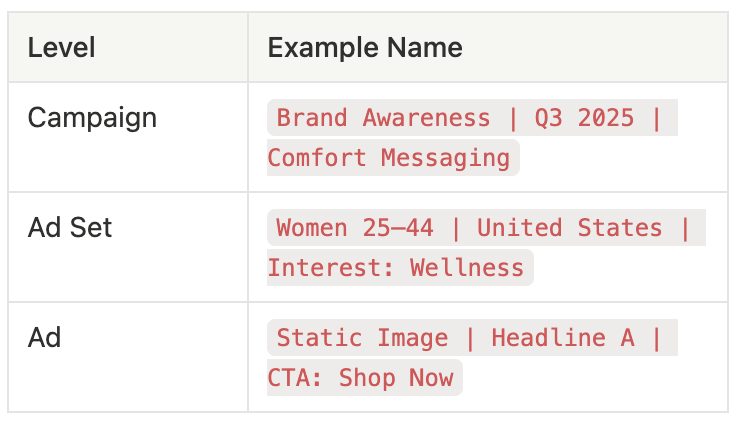
Descriptive names make performance analysis faster, reduce misattribution, and make it easier to hand campaigns off to teammates.
Step 2: Decide Whether to Use Campaign Budget Optimization (CBO)
When building your campaign, you'll see the option to enable Campaign Budget Optimization. In most cases, turn it on. CBO lets Meta automatically shift budget across ad sets in real time, moving spend toward whichever audience is performing best.
The one exception: A/B tests. If you're testing audiences head-to-head, turn CBO off and manually assign equal budgets to each ad set. If CBO is on, the algorithm's budget shifts will skew your results and make it impossible to draw clean conclusions.
Step 3: Run Multiple Ad Variations Per Ad Set
Aim for 2–3 ad variations per ad set. This gives the algorithm creative options to test internally and find the best performer for that specific audience. Vary one element between each ad — the image, the headline, or the primary text — and let the data decide.
This is also where your campaign structure directly enables creative learning. When each ad set has a clear purpose and each ad differs by a single element, it becomes possible to isolate exactly what's driving performance.
Frequently Asked Questions
What is Campaign Budget Optimization (CBO) on Facebook?
CBO is a Meta feature that automatically distributes your campaign budget across ad sets based on real-time performance. It's useful for most campaigns but should be turned off during controlled A/B tests.
How many ads should be in a Facebook ad set?
Meta recommends 2–3 ads per ad set as a starting point. This gives the delivery algorithm enough creative variety to optimize without spreading impressions too thin.
What's the best Facebook campaign structure in 2025?
Most practitioners recommend one objective per campaign, audience segmentation at the ad set level, and 2–3 creative variations per ad set — with CBO enabled unless you're running a structured test.
Key Takeaways
- Campaigns set objectives, Ad Sets define audiences, Ads carry creative — keep decisions at the right level
- Use descriptive naming conventions at every tier
- Enable CBO for most campaigns; disable it for A/B tests
- Run 2–3 ad variations per ad set, varying one element at a time
- Clean structure makes campaign data actionable, not just readable
Turn Campaign Structure Into Creative Intelligence
Purposely.ai breaks down your ad creative element by element — so you always know which visual, headline, or offer is driving results with which audience. Book a demo.


