
How to Build Facebook Ad Creative That Stops the Scroll
Your targeting gets your ad in front of the right person. Your creative is what makes them stop, read, and act. In an era where creative is increasingly the primary driver of paid social performance, getting this right matters more than ever.
Here's a practical framework for building Meta ads that work.
What Makes a Facebook Ad Creative Effective?
Every Facebook ad is built from three core components:
- Visual asset — the image or video that anchors the ad
- Text copy — your Primary Text, Headline, and description
- Destination URL — where the click goes and what happens when it lands
Before you open Ads Manager, have all three ready. Scrambling to pull assets together mid-build leads to rushed decisions — and rushed creative rarely performs.
Step 1: Write Copy That Earns Attention
Your Primary Text (above the visual) and Headline (below it) carry the most weight of any text element in your ad.
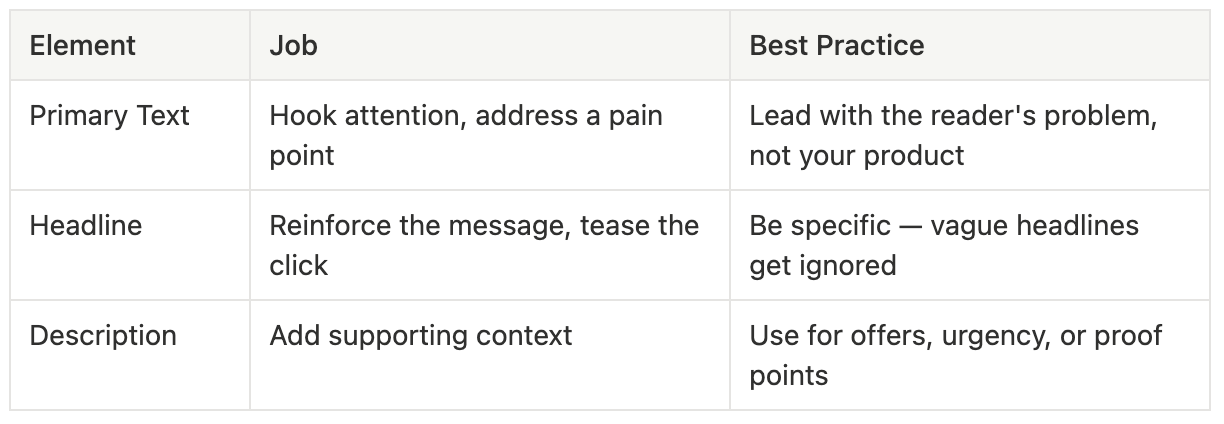
The single most common copy mistake: writing for your brand instead of your audience. The best-performing ad copy reads like it was written by someone who deeply understands the reader's world — not a press release about your product.
Step 2: Match Your Landing Page to Your Ad
A beautifully crafted ad that clicks through to a generic homepage is one of the most reliable ways to kill your conversion rate. Your landing page should be a direct extension of your ad — same message, same visual language, same offer.
The moment there's a disconnect between ad and landing page, you lose the visitor.
A high-converting landing page should:
- Lead immediately with your value proposition
- Keep the design focused with one clear action
- Include social proof — reviews, press mentions, third-party validation — to build trust fast
Step 3: Treat Every Creative Element as a Data Point
The background color, whether a person appears in the image, headline length, font choice — every element is a variable that influences performance. High-performing creative teams don't just make things that look good. They make decisions informed by what has worked before.
This is the shift that separates reactive creative from strategic creative: treating your ad library as a source of intelligence, not just a collection of assets.
Tools like Purposely.ai make this possible — breaking down your creative by individual element so you can see exactly what's driving performance across campaigns.
Frequently Asked Questions
What is the most important part of a Facebook ad?
Research consistently points to the visual as the first thing that stops the scroll, but copy is what converts. Both matter — a strong visual with weak copy underperforms, and vice versa.
How long should Facebook ad copy be?
Primary Text performs best at 1–3 short paragraphs. Lead with your strongest line — most users won't click "See More." Headlines should be concise: 5–7 words is a reliable range.
What should a Facebook ad landing page include?
A clear value proposition above the fold, minimal navigation to reduce drop-off, a single call-to-action, and social proof (reviews, ratings, or press mentions) near the CTA.
Key Takeaways
- Have your visual, copy, and destination URL ready before building
- Write copy for your audience's world, not your brand's voice
- Your landing page must match your ad — message, visual, and offer
- Every creative element is a data point
Turn Your Creative Library Into a Competitive Advantage
Purposely.ai breaks down your ad creative element by element — so your next campaign is always smarter than your last. Book a demo.


